
Jul 17, 2026
An IQF freezing line should be selected around the food, not around a generic equipment catalogue. Shrimp, diced vegetables, fruit pieces, dumplings, poultry portions and sticky cooked products behave differently when they enter sub-zero airflow. Their size, moisture, surface condition, shape, feed temperature and tendency to stick determine whether the line should use an open mesh belt, a solid belt, fluidization, impingement or a combined process.For processors, the commercial objective is also broader than achieving a low product temperature. A successful line must preserve piece separation, control dehydration, protect texture, match upstream production, support hygienic cleaning and deliver a repeatable kilograms-per-hour output without excessive refrigeration demand. Selecting the wrong conveying and airflow concept can create clumps, belt marks, surface cracking, uneven freezing or unstable throughput even when the refrigeration plant is powerful enough.This guide approaches IQF tunnel selection from the product and process perspective. It explains how continuous quick freezing works, compares mesh and solid belt systems, maps food characteristics to suitable technologies and shows how engineering calculations translate a production target into belt area, residence time and refrigeration capacity.
Definition: An IQF tunnel freezer is a continuous food freezing system that moves products through controlled high-velocity cold air so individual pieces freeze rapidly while remaining separated and suitable for downstream handling.IQF means individually quick frozen. The term describes the condition of the product rather than one specific machine design. A properly frozen IQF product should leave the system as separate pieces instead of one solid block. That result is valuable because processors can portion, weigh, blend and package the food accurately, while customers can remove only the required quantity from a bag.
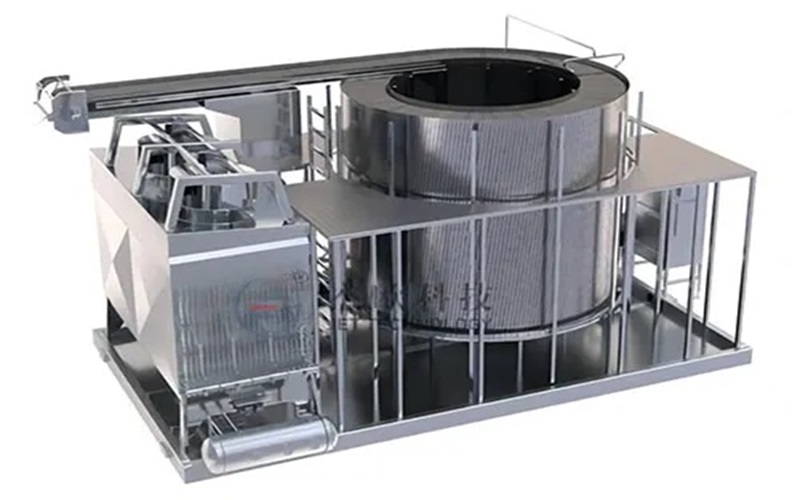
A continuous tunnel normally receives food from a washer, grader, cooker, fryer, forming machine or manual preparation area. A distribution device spreads the incoming food across the conveyor. The belt then carries the product through one or more freezing zones while fans circulate cold air around or through the product layer. At discharge, the frozen pieces may pass to inspection, glazing, weighing, packaging or frozen storage.The process can be divided into three thermal stages:
Pre-cooling: Sensible heat is removed as the product falls from its entry temperature toward its initial freezing point.
Phase change: A large amount of heat is removed while water inside the food changes to ice. This is usually the most demanding part of the freezing curve.
Final cooling: The frozen product is brought to the specified discharge or core temperature.
Codex guidance for quick-frozen foods uses minus 18 degrees Celsius or colder after thermal stabilization as an important reference condition. A freezer, however, generally operates with colder air than the target product temperature. Many industrial IQF projects use design air temperatures in the approximate range of minus 30 to minus 40 degrees Celsius, although the final value depends on food quality requirements, refrigeration method, climate, evaporator design and operating cost.
Low air temperature creates the driving force for heat transfer, but airflow determines how effectively that cold reaches the food surface. Air that bypasses the product or recirculates through an easy path can leave overloaded areas insufficiently frozen. Air that is too aggressive for a delicate product can increase dehydration, move lightweight pieces or damage surface appearance.A tunnel therefore needs balanced air distribution across the usable belt width. Product depth, belt openness, fan pressure, evaporator condition and frost accumulation all influence the actual airflow. A design that performs well with a single layer of peas may not deliver the same result with thick chicken portions stacked several pieces deep.
Residence time is the period between entering and leaving the freezer. It is controlled by conveyor speed and effective belt length. Small blanched vegetable pieces may freeze relatively quickly, while thick meat portions, dough products or packages require more time. Industrial residence times can range from several minutes to well over half an hour, but a product test is more dependable than a universal number.Increasing residence time by slowing the belt can improve final temperature, but it reduces hourly output unless more belt area is available. Increasing air velocity can improve heat transfer, but it also raises fan power and may increase moisture loss. Process design is therefore a balance between product quality, capacity, footprint and energy.
Block freezing intentionally freezes products together in a tray, carton, pan or plate cavity. It is efficient for products sold as blocks, such as certain fish, meat or industrial ingredients. IQF freezing is used when individual pieces must remain separable. It normally requires better feed distribution and more control over product movement because contact between pieces during the early sticky stage can create clusters.Processors should decide the required market format before selecting equipment. If the product will always be thawed as one block, IQF separation may add cost without commercial benefit. When the product is sold in retail bags, mixed recipes or foodservice portions, piece separation usually has direct value.
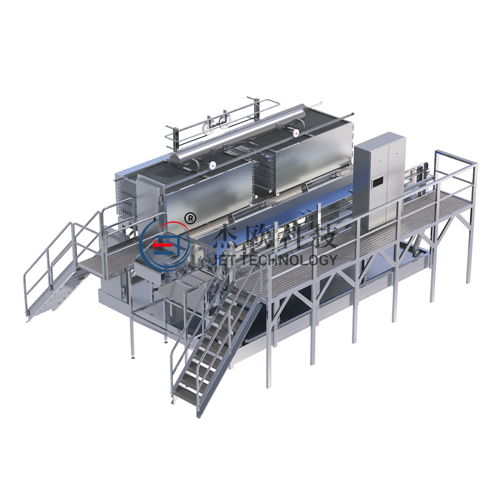
Definition: A mesh belt tunnel freezer uses an open conveyor that allows cold air to pass through the product bed, while a solid belt tunnel freezer supports food on a continuous surface and controls air mainly above and around the product.The belt decision changes the freezing mechanism, sanitation method and appearance of the finished product. It should be made after observing how the food behaves at the entry point, especially during the first minutes when the surface may be wet, soft or sticky.
| Selection Factor | Mesh Belt Tunnel Freezer | Solid Belt Tunnel Freezer | Practical Decision |
|---|---|---|---|
| Air penetration | Air can pass through the belt and product layer | Air does not pass through the belt surface | Choose mesh when through-flow supports rapid, even freezing |
| Typical products | Shrimp, vegetables, fruit pieces, fries, formed foods and many bakery items | Sticky, soft, wet, marinated or small products that need full support | Base the choice on early-stage sticking and deformation risk |
| Product support | Openings may mark very soft food or allow tiny pieces to lodge | Continuous support reduces marking and product loss | Solid belts suit fragile products and liquids or sauces on the surface |
| Dehydration tendency | Higher exposure can improve freezing but may increase moisture loss | Lower underside exposure may reduce some surface drying | Validate yield, not only discharge temperature |
| Cleaning | Requires access to belt openings, hinges and return path | Continuous surface can be easier to inspect but needs effective belt washing and drying | Review the complete sanitation cycle and water management |
| Product release | Generally good after the surface is frozen; wet products may initially stick | Release depends on belt material, surface temperature and product formulation | Test the actual recipe under production conditions |
| Best use | Broad-purpose IQF lines where airflow through the product is beneficial | Products requiring support, controlled contact and a smooth surface | Do not choose from price alone |
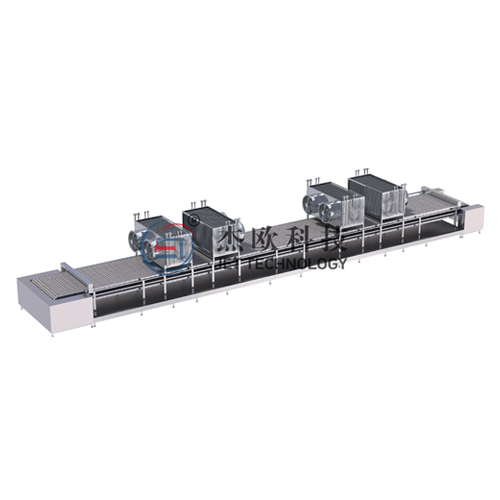
A mesh belt supports cross-flow or vertical airflow through the product bed. This is useful for foods that can be distributed in a loose, relatively shallow layer. Shrimp, diced vegetables, fruit pieces, potato products and many formed foods can benefit from cold air reaching the underside as well as the top surface.Processors comparing systems can review JET's mesh belt tunnel freezer configuration as one reference for a continuous line. The important questions are belt opening, product size, airflow direction, available pressure and how the food is distributed across the belt.Mesh belts are not automatically suitable for every small food. Very tiny pieces can enter belt openings, and soft items can develop marks before their surface firms. A wet product can also freeze to metal if the contact zone is not properly controlled. Feed preparation and the first freezing zone are therefore critical.
A solid belt provides continuous support. It is often considered for products that are soft, sticky, marinated, coated or too small for an open mesh. It can also simplify transfer between upstream equipment and the freezer because there is no open structure beneath the product.The main limitation is that cold air cannot pass directly through the belt. Heat transfer from the underside depends on conduction through the belt and the way air moves around the product. The freezer may therefore require impingement nozzles, optimized top airflow or a carefully controlled product layer to achieve the required residence time.A solid belt should not be described simply as easier to clean. Its flat surface is easy to see, but the complete sanitation result depends on belt joints, edge guides, return rollers, washing equipment and drying. If water remains on the belt before production restarts, it can freeze and create hygiene or tracking problems.
Some foods need one treatment at the beginning and another after the surface hardens. A processor may use an initial crust-freezing zone to prevent sticking, followed by a high-throughput mesh section. Other projects may combine an impingement section with conventional tunnel airflow or use vibration and agitation before stable belt conveying.This is why the belt should not be selected independently from the airflow system. The best solution may be a process sequence rather than one conveyor type from entry to exit.
Definition: Product-based IQF selection means matching conveyor support, airflow, residence time and handling intensity to the food's geometry, moisture, formulation, fragility and tendency to stick.Two foods with the same weight can require different freezing conditions. A compact meatball has a longer heat path to its center than a thin vegetable slice. A wet strawberry surface behaves differently from a dry breaded nugget. A small pea may fluidize, while a similar-size sticky diced fruit may form clusters.
Seafood often enters the freezer with significant surface moisture after washing, grading or glazing preparation. Shrimp and scallops should remain separate, retain natural shape and avoid excessive dehydration. A mesh belt can provide effective through-airflow, but the feed layer should be controlled so pieces do not overlap during the sticky initial stage.For a 1,000-kilogram-per-hour shrimp line, engineering should consider incoming size distribution, water pickup, feed temperature and whether the product is raw, cooked or peeled. Small shrimp can freeze faster than large shrimp, so mixed sizing may produce over-frozen small pieces and warm centers in large pieces. Grading before freezing improves consistency.Seafood processors should also plan for salt, protein and organic residue. Belt washing, evaporator access and drainage must support daily sanitation. Materials and weld finishing should suit the plant's chemical and water conditions.
Many small vegetables are classic IQF products because customers expect free-flowing pieces. Peas, corn and small dices can be suitable for fluidization when air lifts and mixes the product bed enough to reduce contact and clustering. Blanching and cooling conditions have a major influence on surface moisture and freezer performance.A conventional mesh tunnel can work well when the product spreads in a single or shallow layer. A fluidized bed freezer is more appropriate when the product can be suspended or semi-suspended by upward airflow and when strong piece separation is required. The processor should test whether the food is sufficiently uniform and robust for fluidization.Leafy vegetables and lightweight herbs create a different challenge. Excess air velocity can move product irregularly or carry fragments toward the evaporator. Containment, gentle feeding and staged airflow may be more important than maximum velocity.
Fruit contains delicate cell structures and can be vulnerable to juice loss after thawing. Rapid freezing generally supports smaller ice crystals, but physical handling must remain gentle. Berries can roll, bridge or bruise. Diced mango may be sticky because of soluble solids on the surface.For fruit, the engineer should evaluate ripeness, soluble solids, washing method and surface drying. A product entering the tunnel with free water is more likely to form ice bridges. Air knives, vibration, drainage time or pre-cooling may improve separation more effectively than simply lowering the freezer temperature.
Formed foods usually have repeatable geometry, which makes capacity prediction easier. Their challenge is often soft dough, filling leakage or deformation before the crust freezes. A solid belt or carefully selected mesh can provide support, while controlled early-zone airflow sets the surface.Dumplings should be evaluated for wrapper thickness, flour dusting, filling temperature and spacing. Meatballs and formed protein products may roll or collide if air or belt transitions are too aggressive. Stable transfer and product spacing help protect appearance.
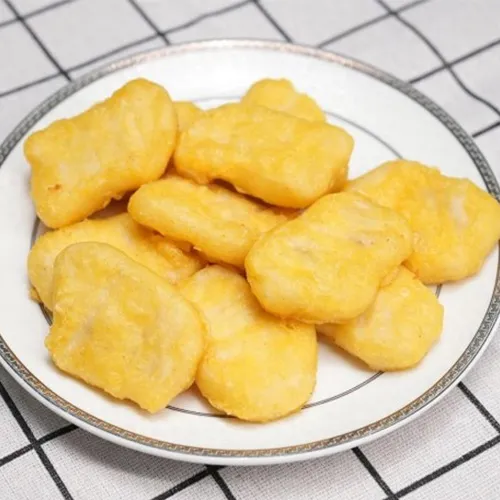
Breaded and fried foods may enter warm and carry surface oil. The freezer must remove both sensible and latent heat while protecting coating adhesion. Airflow that is too strong can dislodge crumbs, while insufficient airflow can extend residence time and reduce line output.The cooling duty should include the actual entry temperature. A product entering at 60 degrees Celsius requires substantially more sensible heat removal than the same product entering at 10 degrees Celsius. Upstream cooling can reduce freezer load, but it may also add floor space and handling. The best arrangement depends on total line economics.
Small pouches, trays or cartons are not truly IQF pieces in the traditional sense, but they can be processed in a continuous tunnel. The package material creates thermal resistance, and air cannot directly contact the food. The line should be sized from the slowest package location and verified with temperature probes.A solid belt may support flexible packs better, while mesh can provide airflow around rigid packs. Package seals, orientation and spacing become part of the freezing design.
Definition: IQF tunnel freezer performance is determined by the interaction between product heat load, air temperature, airflow, belt loading, residence time, evaporator capacity, frost management and upstream feed stability.
The first engineering calculation is the heat that must be removed from the food. A simplified estimate is:Product refrigeration load in kilowatts = mass flow in kilograms per hour × heat removed in kilojoules per kilogram ÷ 3,600.For example, if a line processes 1,000 kilograms per hour and the estimated heat removal from entry to discharge is 300 kilojoules per kilogram, the product load is approximately 83.3 kilowatts. This is not the final compressor capacity. The engineer must add heat from fans, belt motors, infiltration, lights, structure, defrost recovery and safety margin.The 300-kilojoule figure is only an illustrative assumption. Actual enthalpy depends on water, fat, solids, initial temperature, freezing point and final temperature. Product data or test results should be used for a final design.
Hourly capacity is not determined by belt width alone. It depends on kilograms per square meter, residence time and the proportion of belt area that can be used effectively. A nominal two-meter belt may have a smaller usable width because of edges, air seals or product-control requirements.If a product can be loaded at 15 kilograms per square meter and requires 20 minutes, a 1,000-kilogram-per-hour line needs approximately 22.2 square meters of effective occupied belt area:1,000 × 20 ÷ 60 ÷ 15 = 22.2 square meters.The final conveyor length will be larger after allowing for entry, discharge, gaps and non-uniform distribution. If the food must stay in a single sparse layer, the allowable loading may be much lower.
Lower air temperature can increase the temperature difference between air and food, while higher velocity can reduce the resistance at the product surface. Both measures consume energy. Fan power rises strongly as airflow and pressure increase, so the highest possible velocity is rarely the lowest-cost operating point.Air velocity should be evaluated at the food, not only at the fan outlet. Nozzle geometry, product depth, belt blockage and frost can change the local value. Computational analysis can support design, but product trials remain important.
Moisture entering with the food and infiltration air freezes on evaporator surfaces. Frost reduces heat transfer and increases airflow resistance. As a result, a clean system may perform well at startup but lose capacity later in the production run.Engineers should define the required uninterrupted operating period. A line that must run 20 hours between defrosts needs different coil area and frost strategy from a line that stops every 8 hours for sanitation. Coil spacing, face velocity, staged evaporators and defrost scheduling all affect stability.
Uneven feeding is one of the most common reasons a freezer fails to reach expected throughput. If one side of the belt is overloaded while the other side is empty, the overloaded section may leave warm even though average kilograms per square meter appears acceptable.Vibratory feeders, oscillating distributors, lane guides and synchronized upstream controls can improve uniformity. The freezer supplier should understand the actual upstream machine and product delivery pattern.
Energy should be measured per kilogram of acceptable frozen product, not only by compressor nameplate power. Rework, clumping, dehydration and downtime are hidden energy losses. A system with slightly higher electrical demand but better yield may have a lower total production cost. An IQF tunnel freezer should be integrated with the refrigeration plant, upstream feeding and downstream packaging. If the packaging line stops frequently, the freezer needs a strategy for belt occupancy, product residence and temporary accumulation.
Definition: An IQF process design example converts a specific food, entry condition and hourly output into a practical sequence of feeding, freezing, discharge and sanitation operations.
The project begins with size range, initial temperature, water pickup and final core-temperature requirement. The feeding system should create an even layer and separate pieces before they freeze together. A mesh conveyor with through-airflow is often a logical starting point, provided the opening is appropriate for the smallest shrimp.The first zone should set the surface rapidly without blowing lightweight pieces into piles. The later zone completes center freezing. The supplier should conduct tests at both normal and maximum belt loading. The result should be evaluated for clumps, dehydration, belt adhesion, discharge temperature and glazing performance.
The upstream blancher and cooler determine much of the freezing result. If surface water changes during the production day, clumping will also change. Dewatering equipment and feed control may deliver more value than additional compressor power.Fluidization can provide strong separation when the dice are uniform. For mixed sizes or fragile pieces, a gentler mesh tunnel may be safer. Trials should include the smallest and largest product fractions.
Warm dumplings have high sensible heat and a soft surface. A supported belt, stable transfer and a gentle initial airflow zone help prevent deformation. The residence time may be longer than for vegetables because of thickness and filling.The project should define whether the frozen dumplings go directly to bagging or pass through a holding step. Surface frost and package condensation should be controlled.
The line must protect coating while removing heat from the center. Product spacing and entry temperature are critical. Airflow should not strip crumbs. The belt and cleaning system must manage oil and breading residue.Capacity testing should use the heaviest approved portion and the warmest expected entry condition. Designing around an average portion can create under-frozen product during peak production.
Definition: JET Cold Chain provides engineered IQF freezing systems that combine product testing, conveyor selection, airflow design, refrigeration integration and line-support services for food processors.An IQF project is successful when the food leaves the line at the required temperature, quality and separation while the plant can clean, maintain and operate the system reliably. JET approaches the project as a food process rather than a standalone freezer sale.
JET can evaluate food size, entry temperature, surface moisture, hourly capacity and downstream format before recommending a mesh belt, solid belt, fluidized or other tunnel configuration. This reduces the risk of selecting a standard machine that does not suit the actual product.
The tunnel, evaporators, compressors, controls and defrost strategy should be designed as one system. JET can coordinate freezer load with refrigeration equipment and plant utilities, helping buyers avoid mismatched components and unclear responsibility between suppliers.
Seafood, vegetables, poultry and prepared foods each create different handling and sanitation demands. JET can adapt belt material, feeding, drainage, access and operating parameters to the product portfolio. For multi-product factories, recipes and adjustable speed can support different residence times.
Site conditions influence final performance. JET can support layout review, installation guidance, commissioning and operator training. Commissioning should include belt tracking, airflow balance, temperature records, capacity testing, safety checks and sanitation verification.
Product name, dimensions and weight range
Raw, cooked, blanched, fried or coated condition
Entry and required discharge temperatures
Normal and peak kilograms per hour
Surface moisture and sticking tendency
Available room dimensions and ceiling height
Preferred refrigerant and local power supply
Required continuous operating time between defrosts
Sanitation standard and cleaning schedule
Upstream and downstream equipment details
Providing these details allows JET Cold Chain to prepare a more accurate process recommendation, layout and utility estimate instead of a generic quotation.
Definition: These IQF tunnel freezer FAQs address the practical process, capacity and technology questions asked by seafood, vegetable, poultry and prepared-food processors.
An IQF tunnel is normally a continuous system designed to freeze individual pieces while maintaining separation. A blast freezer is often a batch room or cabinet used for trays, racks, cartons or bulk products. Some blast systems can freeze individual items, but they do not necessarily provide continuous conveying or consistent piece separation.
Yes, mesh belt systems are widely applicable to shrimp because cold air can reach the product from several directions. The correct mesh opening, airflow, feed distribution and surface-water control must be confirmed for the shrimp size and processing condition.
Residence time depends on size, shape, composition, entry temperature, final temperature, air conditions and belt loading. Small vegetables may require only several minutes, while thicker formed foods can require much longer. Product trials should determine the design value.
Choose mesh when through-airflow and rapid exposure around the product are important. Choose solid belt when the food is sticky, soft, very small or requires continuous support. Evaluate sanitation, product release and surface appearance in addition to freezing time.
Industrial tunnels can be integrated with ammonia, carbon dioxide or suitable fluorinated refrigerant systems depending on plant scale, regulations and owner preference. The evaporating temperature, compressor capacity, defrost method and control strategy must match the freezer load.
Capacity can range from several hundred kilograms per hour to several tonnes per hour. It depends on product heat load, residence time, belt area, allowable loading and refrigeration capacity. The supplier should quote capacity for a defined product and entry condition rather than a generic maximum.
Definition: The best IQF tunnel freezer is the system whose belt, airflow, residence time and refrigeration design match the real behavior of the food throughout the freezing curve.Mesh belt, solid belt and fluidized systems should not be treated as interchangeable equipment categories. A mesh belt supports through-airflow and broad IQF applications. A solid belt supports soft or sticky products. Fluidization can create excellent separation for suitable small particles. Hybrid processes may be the strongest option when the food changes behavior after crust freezing.Processors should provide accurate product data, test the most difficult operating condition and evaluate separation, yield, quality, sanitation and energy together. JET Cold Chain can use this information to configure an industrial IQF line that connects upstream preparation, continuous freezing, refrigeration and downstream packaging.
Definition: The following official sources provide food-freezing, quick-frozen product and temperature-control references relevant to IQF tunnel projects.
FAO/WHO Codex Alimentarius — International Food Standards: https://www.fao.org/fao-who-codexalimentarius/codex-texts/list-standards/en/
USDA Food Safety and Inspection Service — Freezing and Food Safety: https://www.fsis.usda.gov/food-safety/safe-food-handling-and-preparation/food-safety-basics/freezing-and-food-safety
European Union — Directive 89/108/EEC on Quick-Frozen Foodstuffs: https://eur-lex.europa.eu/legal-content/EN/TXT/?uri=CELEX:31989L0108
 English
 français
 Deutsch
 Español
 русский
 العربية


