
Aug 04, 2026
An impingement tunnel freezer is a continuous mechanical freezing system that directs high-velocity cold air at the upper and lower surfaces of food moving on a conveyor. The concentrated jets disturb the warm boundary layer that normally insulates the product, increasing surface heat transfer and helping thin or flat foods freeze rapidly and consistently. For food processors, the practical value is not simply “colder air.” It is the combination of controlled airflow, short heat-transfer distance, repeatable belt loading, hygienic access and a refrigeration system sized for the real product load.
This guide is written for plant owners, project engineers, production managers, quality teams and procurement specialists who are evaluating an impingement line for hamburger patties, fish fillets, shrimp portions, flat bakery items, prepared foods or crust-freezing duties. It explains where the technology fits, where it does not fit, which numbers must be verified, how to compare it with other IQF systems and what information a manufacturer needs before providing a responsible proposal.
JET Technology develops industrial quick-freezing equipment and integrated food-processing solutions. Its published impingement model examples include capacities from approximately 250 to 1,500 kg/h, belt widths from 1,200 to 1,800 mm and reference products such as raw dumplings and hamburger patties. Those figures are useful starting points, not universal promises. Actual capacity depends on product dimensions, composition, surface condition, inlet temperature, target core temperature, belt loading, air condition, defrost schedule and operating hours.
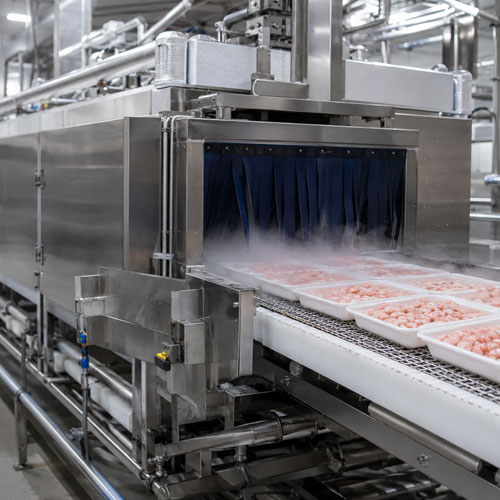
An impingement tunnel freezer is a conveyorized freezer in which arrays of nozzles send high-speed refrigerated air directly toward the product surface. Conventional air circulation can leave a relatively slow-moving film of air around the food. That film acts as thermal resistance. Impingement nozzles repeatedly replace it with colder moving air, so the surface gives up heat more quickly.
The process can be understood in five stages. First, properly spaced products enter the enclosure on a mesh or solid conveyor. Second, fans move refrigerated air through engineered pressure ducts. Third, nozzles accelerate and direct the air toward the top and, in many systems, the bottom of the food. Fourth, the product travels through one or more controlled zones until it reaches the specified surface or core condition. Fifth, the frozen or crust-frozen product leaves the tunnel for glazing, inspection, packaging, tempering or another downstream step.
The important engineering point is that nozzle velocity alone does not define performance. A system also needs uniform pressure distribution across the usable belt width. If the center receives stronger airflow than the edges, or if upstream rows block downstream rows, the outlet temperature distribution may be unacceptable even when average capacity looks good. A credible proposal therefore considers duct geometry, nozzle-to-product distance, belt openness, product spacing, evaporator condition, fan control and the thermal load entering each zone.
Impingement is especially effective when the product is thin enough for internal conduction not to become the dominant limitation. Once the surface cools rapidly, heat still has to travel from the product center to the surface. This is why a thin patty can benefit more dramatically than a thick block of meat. FAO guidance on food freezing notes that product thickness, shape, initial temperature, packaging and heat-transfer conditions all affect freezing time. In high surface heat-transfer conditions, freezing time can rise sharply as thickness increases. For buyers, that means the thickest regular product—not the average product—often controls the required dwell time.
An impingement tunnel freezer fits thin and flat foods because it delivers intense, directional surface cooling to products with a short distance between the surface and thermal center. The technology is commonly considered for formed meat products, fish portions, flat seafood, breaded pieces, pizza components, dough products and other items that can be arranged in a stable single layer.
Hamburger patties are a classic example. Their broad faces create a large heat-transfer area, while controlled belt loading keeps pieces separated. Rapid surface cooling can help stabilize shape before the patties encounter handling, stacking or packaging operations. The design target may be complete freezing to a required core temperature, or only enough crust formation to support slicing, portioning or downstream transport. These are different duties and should not be quoted as if they require the same tunnel length and refrigeration load.
Fish fillets and flat seafood portions can also be suitable, particularly when processors want fast freezing with limited dehydration and consistent shape. However, the product surface may be wet, glazed, irregular or delicate. The manufacturer must assess whether high air velocity will move lightweight pieces, disturb coatings or increase belt marking. Nozzle arrangement, belt choice and staged fan control can be more important than simply selecting the highest available air speed.
Shrimp products require more careful definition. Individually loose shrimp, especially small wet pieces, may be better suited to fluidization or a mesh-belt arrangement that encourages separation. Formed shrimp cakes, flat portions or products held in trays may fit impingement more naturally. The correct answer depends on whether the commercial goal is individual separation, crust freezing, complete freezing, surface hardening or retention of a specific presentation.
Bakery and prepared foods add another variable: surface sensitivity. High airflow can be useful for flat dough, pizza bases, pancakes or packaged portions, but uncovered toppings, light garnishes and soft surfaces may move or dry. A staged tunnel can use gentler inlet conditions followed by more aggressive freezing after the surface sets. The most useful test is a representative product trial using the actual formulation, dimensions, inlet condition, belt arrangement and target output.
JET’s published page describes impingement as suitable for shrimp products, fish fillets, hamburger patties and other thin foods. A buyer should treat this as an application range, then verify the specific product through engineering calculations and, where possible, a trial or documented reference. Product family names alone are not enough. A 10 mm fish portion and a 45 mm stuffed fillet create very different requirements.
An impingement freezer differs from other IQF systems mainly in how it brings cold air into contact with the product and which product geometry it handles best. The correct comparison should include product form, required separation, footprint, residence time, sanitation, line flexibility and operating cost—not only nominal kilograms per hour.
| Freezing system | Best-fit product condition | Main heat-transfer approach | Typical strengths | Key limitations to check |
|---|---|---|---|---|
| Impingement tunnel freezer | Thin, flat or formed products arranged in a controlled layer | High-velocity jets directed at top and/or bottom surfaces | Fast surface cooling, compact duty for suitable products, crust-freezing capability, repeatable continuous flow | Performance falls as thickness increases; lightweight toppings or wet products may move; nozzle and belt sanitation must be accessible |
| Mesh belt or solid belt tunnel | Seafood, poultry, bakery, prepared food, packaged or sticky products depending on belt | Crossflow or multi-directional cold-air circulation around a conveyor | Broad product flexibility, straightforward line integration, multiple belt options | May need longer residence time; airflow can be obstructed by dense loading; belt choice affects release and marking |
| Fluidized bed IQF freezer | Small, separate pieces such as peas, berries, diced vegetables or suitable shrimp | Upward air and mechanical action suspend or mobilize pieces | Strong individual separation and uniform exposure for small particles | Not appropriate for large, fragile, sticky or highly irregular products without testing |
| Spiral freezer | High-throughput lines that need long dwell time in a compact floor area | Cold-air circulation around a long conveyor arranged vertically | High belt capacity, long residence time, compact footprint relative to belt length | More complex belt path and structure; sanitation, belt tension and product transfers require close review |
| Plate freezer | Regular blocks, cartons or products that can contact refrigerated plates | Direct conductive contact with refrigerant-cooled plates | Efficient heat transfer for regular packages, compact block freezing | Needs good contact and controlled dimensions; not a general solution for loose individual pieces |
| Cryogenic freezer | Flexible products, startup lines, very fast surface freezing or limited floor space | Liquid nitrogen or carbon dioxide removes heat at very low temperature | Fast response, compact equipment, lower initial mechanical complexity in some cases | Ongoing cryogen cost and supply logistics; ventilation and operating economics must be evaluated |
A processor choosing between systems should begin with product physics and commercial output. The tunnel freezer category is useful when the line can use a horizontal continuous path and the product can be presented consistently. A spiral becomes attractive when the required residence time is long and floor space is constrained. Fluidization is valuable when separation of small pieces is the central quality requirement. Plate freezing is compelling for regular blocks or packages with good contact surfaces.
The table should not be interpreted as a rule that one technology always produces better quality. Quality depends on how quickly and uniformly the actual product passes through the critical phase-change range, how much moisture is lost, whether the product deforms, how the surface responds to airflow and whether the cold chain remains stable after freezing. A poorly loaded high-performance freezer can produce worse results than a well-operated simpler system.
Impingement tunnel freezer capacity is the mass of a defined product that a defined machine can process per hour while meeting a stated outlet condition. A responsible capacity statement always includes the product, piece dimensions, formulation or water content when relevant, inlet temperature, target core or surface temperature, belt loading pattern, ambient conditions and defrost assumptions.
JET publishes several impingement model examples. One series lists raw dumplings entering at 20°C and leaving at -18°C, with nominal capacities from 250 to 1,500 kg/h depending on model. Another series references hamburger patties entering at 4°C and leaving at -18°C, with nominal capacities from 500 to 1,500 kg/h. Published belt widths include 1,200, 1,250, 1,500 and 1,800 mm, while standard product-height limits are shown around 35 or 50 mm for certain series. These numbers illustrate why two products cannot be compared solely by kilograms per hour: the starting temperature and geometry are different.
Start the sizing discussion with the required saleable output, not gross incoming weight. If a line needs 1,000 kg/h of packed frozen patties and expects 2% process loss, stoppages and product changeovers, the nominal freezer input requirement may need to be higher. The manufacturer should also understand the shift pattern. A plant running 16 hours with a planned sanitation break has different defrost and redundancy needs from a plant that requires a 22-hour continuous campaign.
Next define the belt load. Pieces per row, row pitch and belt speed determine how much product enters the freezing zone. Overloading can reduce airflow exposure, create contact points, increase outlet temperature variation and make the nominal kg/h number meaningless. Underloading may meet temperature easily but use equipment and energy inefficiently. A good design establishes an operating window rather than one theoretical maximum point.
Residence time is determined by effective belt length divided by belt speed. However, the “effective” freezing length is not always the external enclosure length. Infeed transitions, discharge sections, service zones and airflow dead areas may not contribute equally. Ask the supplier to show the active freezing zone, speed range and expected residence time for the reference product.
Finally, define acceptance. “Frozen” is too vague. The requirement may be maximum core temperature at discharge, average core temperature, percentage of pieces below a limit, surface temperature for crust freezing, temperature distribution across belt lanes, weight loss, shape retention or package integrity. FDA consumer guidance uses 0°F (-18°C) as the recommended freezer storage temperature, while quick-freezing equipment may operate with much colder air to drive heat transfer. The tunnel air setpoint and the final product core temperature are not the same number.
Product-specific design decisions translate food geometry and process risks into belt, airflow, temperature and sanitation choices. The same impingement enclosure can perform very differently when the product changes from chilled patties to warm dumplings or from dry breaded portions to wet fish fillets.
For patties, collect diameter, thickness, weight, fat level, formulation, inlet temperature, surface moisture and whether paper interleaves or trays are present. Ask whether the goal is shape setting, crust freezing or full core freezing. If the patty is soft at infeed, the transfer onto the belt must avoid folding or edge damage. If the product is breaded, the airflow and transfer design must minimize coating loss. If the line feeds an automatic stacker, the outlet temperature distribution and piece flatness may be as important as average capacity.
For fillets, record thickness distribution rather than average weight only. A batch with a wide thickness range can create a choice between over-freezing thin pieces and under-freezing thick pieces. Surface water, skin-on versus skinless condition, glazing, orientation and belt marking should be evaluated. The processor may also need to control dehydration and color. A representative test should weigh samples before and after freezing using a defined method.
For bakery products, identify whether the dough is proofed, par-baked, fully baked or topped. Airflow that is acceptable for a firm pizza base may disturb grated cheese or herbs. Trays and packaging add thermal resistance but may protect presentation. Warm products arriving directly from cooking create a much larger product load than pre-chilled products, so upstream cooling can reduce tunnel size and refrigeration demand.
Dumplings can vary in filling temperature, wrapper moisture, fold geometry and contact area. A solid belt can support soft products but may reduce bottom-side airflow compared with an open belt. A mesh belt can improve exposure but may leave marks or allow soft dough to deform. The design should balance release, airflow, sanitation and product appearance.
When a product is not naturally suited to impingement, JET can evaluate alternatives such as a spiral freezer manufacturer solution for long residence time and high belt capacity, or a different tunnel configuration for small separated pieces. The aim is not to force every inquiry into one machine; it is to match the freezing mechanism to the product and plant.
Hygienic design in an impingement tunnel freezer means that food-contact and splash-zone areas can be accessed, cleaned, inspected, drained and returned to service without creating hidden contamination risks. Because impingement systems use pressure ducts and many air openings, the cleaning strategy must cover more than the visible belt and floor.
Ask how operators access the conveyor return, nozzle plates, fan area, evaporator face, drain points, belt supports, infeed and discharge transitions. Removable parts should have a controlled removal and reinstallation method. Hinged or liftable components should not create pinch hazards or require unsafe manual handling. Welds, joints, fasteners and insulation interfaces should be reviewed for water traps and difficult-to-inspect gaps.
Drainability matters because water left after sanitation can refreeze, create ice, damage components or become a hygiene concern. The enclosure floor should direct water toward accessible drains. The sanitation plan should specify rinse direction, chemical compatibility, pressure limits, inspection points and drying or pre-cooling procedures before production restarts.
Frost on the evaporator reduces airflow and heat-transfer performance. JET states that the fan arrangement on its impingement design places the fan on the “dry side” of the evaporator to reduce frost formation and extend operating time. Buyers should ask for the expected continuous run duration for their actual product moisture load and plant humidity, not a generic maximum. Wet products, frequent door opening and humid infeed conditions can shorten run time.
Defrost options may include scheduled shutdown, hot-gas defrost, water defrost, air defrost or sequential arrangements depending on the refrigeration system and equipment design. Every method affects utility use, sanitation time, restart stability and production scheduling. A long continuous run is valuable only if the freezer can then be cleaned and returned to stable operation efficiently.
The hygienic discussion should connect to the plant’s food-safety management system. ISO 22000 integrates hazard control, prerequisite programs and management-system requirements across the food chain. EHEDG guidance emphasizes that equipment with poor hygienic design is difficult to clean. A manufacturer does not “certify” the customer’s complete food-safety outcome merely by using stainless steel. The equipment, installation, cleaning procedure, verification and operator discipline work together.
The refrigeration and control system behind an impingement tunnel freezer supplies the low-temperature air condition and stable capacity needed to remove the product heat load. The freezer enclosure, evaporator, fans, compressor plant, valves, defrost arrangement and controls must be designed as one system.
The product load includes sensible cooling above the initial freezing point, latent heat removed during phase change and sensible cooling below freezing. Additional loads come from fan motors, conveyor drives, enclosure transmission, infiltration, lights, people during service, defrost recovery and other equipment. These loads vary over the production cycle. A preliminary estimate is useful, but final selection requires product and operating data.
ASHRAE has published an order-of-magnitude estimate of about 40 tons of refrigeration per ton of product per hour for IQF freezers. This is not a purchase specification. Product temperature, moisture, final temperature, freezer efficiency, fan power, infiltration and safety margin can move the real value materially. It is best used as a reasonableness check while detailed enthalpy and equipment calculations are developed.
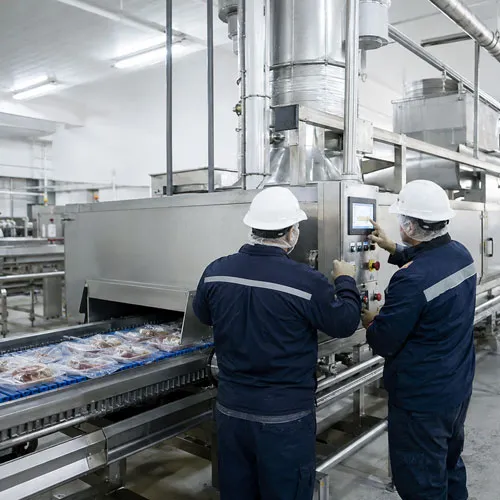
Controls should stabilize air temperature, fan operation, belt speed and alarm handling. A recipe can store validated settings for each product, but recipes should have permission control and change records. Operators need visibility into inlet/outlet air temperature, evaporator condition, fan status, belt speed, defrost state and critical faults. Data logging helps troubleshoot capacity loss and supports FAT/SAT evidence.
The refrigeration system may use ammonia, fluorinated refrigerants or a CO₂-based arrangement depending on plant scale, regional regulations, service capability and project requirements. The freezer manufacturer and refrigeration integrator must agree on evaporating condition, refrigerant feed, pressure drop, defrost, controls, oil management, safety interfaces and commissioning responsibilities. Ambiguous scope boundaries are a common source of delay.
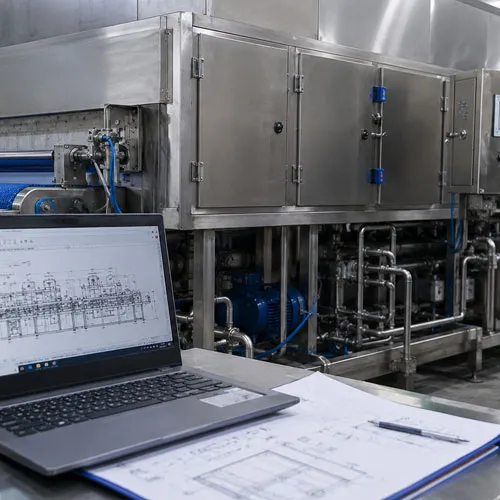
A JET impingement freezing project should convert the buyer’s product and plant constraints into a documented technical basis before a model is selected. The process begins with product data, continues through thermal and mechanical design, and ends with acceptance evidence and operator training.
The first deliverable should be a design-input sheet. It records product name, formulation category, dimensions and tolerances, piece weight, surface condition, packaging or tray, inlet temperature, required output condition, kg/h, operating hours, cleaning method, available utilities, refrigerant preference and site dimensions. Photographs and short production videos can reveal loading and transfer risks that a spreadsheet misses.
The second stage is concept selection. JET can compare impingement with mesh-belt, solid-belt, fluidized-bed, spiral or plate options. The recommendation should explain why the mechanism suits the product, not merely list equipment. A layout drawing should show line direction, access zones, maintenance clearances, panel opening, evaporator removal route, drains, platforms and interfaces with upstream and downstream machines.
The third stage is detailed engineering and risk review. Key questions include belt material and support, nozzle access, airflow uniformity, fan and motor selection, evaporator fin spacing, defrost, insulation, floor loading, electrical standard, control architecture, food-contact materials, safety guarding and cleaning. Project-specific claims should be marked as calculated, assumed or guaranteed.
The fourth stage is factory acceptance testing. FAT may include visual and dimensional checks, material certificates, motor and instrument verification, belt tracking, control sequence, alarm tests, dry run, refrigeration interface checks and, when feasible, product testing. If a full-load product trial cannot be completed at the factory, the contract should define which results will be verified during site acceptance.
The final stage is installation, commissioning, SAT and training. Site acceptance should use agreed product and operating conditions. Measure samples across the belt width and over time, not only one “best” piece. Record throughput, inlet temperature, outlet core or surface temperature, belt speed, air condition, utility data and deviations. Operator training should cover recipes, loading limits, sanitation, defrost, alarms, daily inspection and preventive maintenance.
An impingement freezer RFQ checklist is a structured set of product, process, site and acceptance data that enables suppliers to compare the same duty. Sending only “1,000 kg/h hamburger patty freezer” encourages inconsistent assumptions and quotes that cannot be compared responsibly.
Product identity: exact product, raw/cooked status, formulation category and whether it is coated, glazed, topped or packaged.
Geometry: length, width, thickness, piece weight, tolerances and the thickest regular product.
Thermal condition: minimum, normal and maximum inlet temperature; target core, surface or crust condition at discharge.
Capacity: normal and peak kg/h, pieces per minute, required line availability and shift schedule.
Loading: number of lanes, piece spacing, orientation, belt loading density and transfer method.
Quality limits: allowable weight loss, shape change, belt marking, coating loss, temperature spread and clumping.
Sanitation: allergens, cleaning chemicals, water temperature, washdown pressure, sanitation window and verification method.
Utilities: refrigerant/system condition, electrical supply, water, drainage, compressed air and control network.
Site: room length, width and height; doors; columns; floor load; maintenance route; ambient temperature and humidity.
Standards: destination-country electrical, pressure, machine safety, food-contact and documentation requirements.
Acceptance: product, test duration, sample plan, temperature method, capacity definition, utility measurement and remedy if results are not met.
Frequently asked questions about impingement tunnel freezers address product fit, freezing speed, temperature, sanitation, capacity and comparison with other systems.
Thin, flat and consistently presented foods are usually the strongest candidates. Examples include hamburger patties, fish fillets, formed seafood portions, flat breaded products, pizza components, pancakes and selected dumplings or prepared foods. Very thick blocks, highly irregular piles and small loose particles may be better served by another freezing method.
No. It can provide faster surface heat transfer for suitable geometry, but total freezing time may still be limited by product thickness, composition, inlet temperature, packaging and internal conduction. The comparison must use the same product, outlet requirement, loading and operating condition.
The air setpoint is project-specific and is normally below the desired product outlet temperature. Many industrial quick-freezing systems operate in a low-temperature range around -35°C to -40°C, but the correct setpoint depends on product, refrigeration design, capacity, quality and energy targets. Do not confuse tunnel air temperature with final core temperature.
Yes. The system can be designed to set or harden the product surface before slicing, handling, stacking or packaging. Crust-freezing duty usually requires a different residence time and acceptance criterion from complete core freezing, so the RFQ must state the exact target.
Capacity should be verified using an agreed product, inlet-temperature range, loading pattern, operating duration and outlet-temperature sampling plan. Samples should cover multiple belt lanes and times. The test record should include belt speed, air condition, defrost state and any product deviations.
JET needs product dimensions, weight, inlet and target temperature, hourly throughput, belt loading, operating hours, sanitation method, refrigerant preference, site dimensions, utility data and applicable standards. Photos, drawings and representative samples improve the accuracy of the recommendation.
An impingement tunnel freezer is most valuable when a food processor has a thin or flat product, a stable single-layer presentation and a clear requirement for rapid surface or complete freezing. Its high-velocity jets can increase surface heat transfer by disturbing the insulating boundary layer, but successful performance still depends on internal product conduction, uniform airflow, controlled belt loading, refrigeration capacity, sanitation and defrost strategy.
The best buying decision is therefore not based on the largest fan, the lowest air temperature or the highest unqualified kg/h claim. It is based on a documented duty and a testable acceptance plan. JET Technology can use product data, site constraints and operating requirements to compare impingement with other mechanical freezing options and develop a project-specific line proposal. Before requesting a quote, prepare the product geometry, temperature, capacity, quality, cleaning, utility and acceptance information listed in this guide.

 English
 français
 Deutsch
 Español
 русский
 العربية


