
Sep 18, 2026
The conveyor belt inside a tunnel freezer is not a minor mechanical detail. It determines how the product is supported, how cold air reaches the underside, where moisture and crumbs can move, how easily soft products deform, and how the line can be cleaned. That is why choosing between a solid belt and a mesh belt can materially change freezing performance even when the insulated enclosure, evaporator and refrigeration plant look similar.
A mesh belt provides an open surface that can promote airflow and drainage through the conveying area. A solid belt provides continuous support and a closed surface that can be advantageous for soft, wet, sticky, small or irregular products that should not sag through openings or leave material below the conveyor. Neither belt is universally superior. The right selection depends on food geometry, surface condition, heat-transfer strategy, sanitation design and the way the product enters and leaves the freezer.
This guide focuses on industrial continuous tunnel freezing for seafood, meat, pastry, prepared food and other products. It explains how belt design interacts with airflow, gives a practical comparison table, uses JET Technology's published tunnel-freezer figures as reference data, and outlines the questions a processor should answer before requesting a final freezer configuration.
A solid belt tunnel freezer is a continuous freezer that carries food through a cold-air tunnel on a continuous, non-open conveyor surface that fully supports the product from below.
The solid belt may be selected for products that are soft, wet, sticky, small, irregular or sensitive to belt impressions. Because the conveying surface is continuous, small pieces and liquid drips are less likely to fall directly through the belt. This can simplify product containment, although the freezer still needs a deliberate drainage and cleaning strategy.
A solid belt also changes the heat-transfer path. Air cannot pass vertically through a closed belt in the same way it can through an open mesh. The freezer designer therefore has to manage top-side airflow, side airflow, belt thermal behavior and product spacing to achieve the required freezing result.
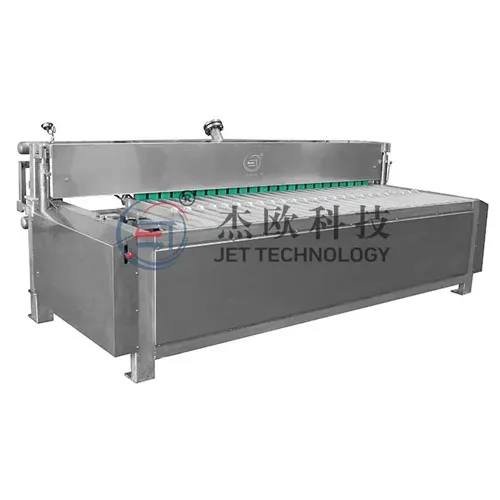
JET's combined mesh-belt/solid-band tunnel freezer page publishes example capacities from 300 to 1,000 kg/h under referenced aquatic-product conditions. The listed examples include belt widths from 1,200 to 2,600 mm and use a 20°C inlet and -18°C outlet product temperature as the reference condition. Those values are useful for understanding equipment scale, but the final design depends on the real product and production conditions.
A buyer searching for a solid belt tunnel freezer should therefore send the supplier information about product softness, moisture, footprint on the belt, allowable belt marking, inlet temperature and target core temperature before selecting a model.
A mesh belt tunnel freezer is a continuous freezer that transports food on an open conveyor surface, allowing air and moisture to pass through the belt openings depending on the airflow design.
Open belts are widely used because they allow cold air to access more of the product surface and can support multi-directional air circulation. They can be effective for seafood pieces, poultry, pastry, formed foods and many other products that are mechanically stable enough to sit on the mesh without unacceptable marking or deformation.
Mesh geometry matters. Opening size, wire or plastic structure, belt thickness and support arrangement affect airflow resistance, food contact and cleaning. A mesh that works well for a large breaded product may be unsuitable for rice, small vegetable pieces or a very soft fish portion.
Drainage can be an advantage when water or glaze needs to leave the product area, but the material that passes through the belt still has to go somewhere. Floor pans, drip trays, drains and cleaning access must be designed so moisture and crumbs do not accumulate in inaccessible places.
In other words, “mesh belt” is not one specification. Procurement should identify belt material, opening size, food-contact requirements, tensioning method, cleaning access and replacement procedure as part of the freezer design.
The main difference is that a solid belt gives continuous product support while a mesh belt creates an open conveying surface that can increase air and liquid passage through the belt.
| Selection Factor | Solid Belt Tunnel Freezer | Mesh Belt Tunnel Freezer |
|---|---|---|
| Product support | Continuous support across the belt | Support distributed through mesh structure |
| Airflow through belt | Limited; airflow is managed around exposed surfaces | Possible depending on mesh and air-path design |
| Drainage through belt | Limited; liquids stay on or move along the belt until drained | Water and small debris may pass through openings |
| Risk of belt marks | Generally lower for flat supported product | Depends on mesh geometry, product softness and load |
| Very small pieces | Can be easier to contain | Opening size must be checked carefully |
| Soft or sticky foods | Often worth evaluating for continuous support | Release behavior and marking need testing |
| Cleaning focus | Belt surface, underside, edges and drainage | Mesh openings, supports, underside and drip collection |
| Best choice determined by | Food shape, moisture, loading, airflow, hygiene, transfer points and required freezing result | |
The freezer air system and belt should be engineered together. A mesh belt does not automatically guarantee better freezing merely because air can pass through it, and a solid belt does not automatically reduce heat transfer to an unacceptable level. Air direction, velocity, temperature, belt loading, product spacing and residence time collectively determine the result.
Both configurations are part of the wider tunnel freezer family, so buyers should compare full process designs rather than comparing belt material in isolation.
Seafood belt selection depends on whether the product needs drainage and multi-sided airflow or continuous support that protects soft flesh and limits marking.
Seafood is not one process category. Whole fish, fillets, shrimp, scallops, squid, battered portions and glazed products all behave differently. A firm individually separated shrimp product may tolerate or benefit from an open belt. A soft fillet may need more support. A heavily glazed product can introduce water that changes both heat load and hygiene requirements.
For fish fillets, belt marking can become a commercial quality issue. If the flesh is soft at the freezer inlet, mesh geometry and local contact pressure should be evaluated through trials. A solid belt may reduce imprinting, but its airflow strategy still needs to freeze the center within the required residence time.
Shrimp and scallops introduce a different question: individual separation. If the pieces are small and free-flowing, a fluidized bed freezer may deserve evaluation alongside both belt-tunnel options because controlled air movement can help separate small pieces during crust freezing.
For any seafood project, provide size grading, glaze percentage if applicable, inlet temperature, product spacing, target outlet temperature and the maximum acceptable dehydration or breakage. A useful supplier test should use the same raw-material condition expected in commercial production.
Meat and prepared-food belt selection should match the product's structural strength, surface coating, oil or moisture release, and the need for airflow around the lower surface.
Firm formed products such as patties, nuggets or portioned meat can often run successfully on open belts, provided the mesh does not create unacceptable marking. Breaded products may shed crumbs, which makes underside access and residue collection important.
Soft marinated products can stick to certain surfaces. Release behavior at the freezer discharge should therefore be tested. The best belt is not simply the belt that transports the food into the freezer; it must also release the frozen product cleanly to the next conveyor without tearing coatings or leaving frozen residue.
Prepared foods can be even more varied. Dumplings, pastries, dough products, meal components and coated snacks may need different support, spacing and airflow. Some foods benefit from rapid crust formation that stabilizes the surface before deeper freezing. Others need gentle airflow to reduce dehydration.
The procurement team should identify the mechanically weakest SKU and the thermally hardest SKU. If those are different products, the freezer must be checked against both cases before a belt is finalized.

Airflow design controls how cold air contacts the food and returns to the evaporator, while belt openness changes the resistance and pathways available to that air.
With a mesh belt, air may pass through the conveyor and contact the underside of the food, depending on product coverage and the freezer's duct arrangement. With a solid belt, airflow must predominantly reach the food from above, the sides or other engineered directions. That does not mean the solid-belt system cannot freeze efficiently; it means the air path must be designed for the closed surface.
Product loading can block airflow even on an open belt. If pieces overlap or the belt is covered as a continuous layer, effective open area decreases. This is why kg/m² and spacing are as important as belt type.
Air velocity should also be selected around the product. Too little airflow can slow heat transfer; too much can move lightweight products, damage delicate surfaces or increase dehydration. The target is controlled heat transfer, not maximum fan speed.
JET's combined tunnel-freezer product information describes multi-directional airflow within a sealed tunnel and variable belt speed through inverter control. In a real project, ask the supplier for the airflow concept, fan arrangement, evaporator position and expected pressure path rather than accepting a generic phrase such as “360-degree freezing.”
Tunnel-freezer capacity is determined by the interaction of product heat load, usable belt area, loading density, residence time, airflow and refrigeration duty.
Wider is not automatically higher capacity. A wider belt can carry more product only if the airflow and refrigeration system can remove the additional heat. Similarly, increasing belt loading can reduce exposure of food surfaces and change freezing time.
JET's published combined tunnel-freezer examples illustrate the scale relationship: listed capacities range from 300 to 1,000 kg/h, with belt widths from 1,200 to 2,600 mm depending on the model. One listed model also shows a product-height limit of 50 to 200 mm. These are useful reference values for a particular equipment family, but they do not replace product-specific thermal calculations.
Consider a hypothetical requirement of 800 kg/h. If a proposed freezer needs 20 minutes residence time, the conveyor must contain roughly 267 kg of product in the freezing zone at steady state, before considering start-up transients and distribution. How that mass is spread across the belt influences airflow and contact.
For a meaningful quotation, define the same basis for every supplier: product size, inlet temperature, target outlet core temperature, kg/h, hours per shift, allowable belt loading and expected residence time. Otherwise, two capacity numbers can describe very different operating conditions.
A freezing target defines the final product condition to be achieved, including the required core temperature and quality attributes, rather than relying only on the freezer's air-temperature setpoint.
Codex guidance for quick-frozen foods states that the quick-freezing process should pass rapidly through the maximum ice-crystallization range and should not be regarded as complete until the thermal center reaches -18°C or lower after thermal stabilization. This is a useful benchmark for specifying the product result.
FAO technical guidance explains why freezing rate matters: faster freezing generally creates smaller ice crystals and reduces cell damage compared with slow freezing. Belt choice contributes indirectly because it changes airflow and product support, but the full freezing rate depends on the complete system.
For commissioning, measure core temperature in representative pieces, not just surface temperature. Identify the thickest product and the hardest location on the belt. Where the freezer processes several SKUs, validate settings for each major product family.
USDA guidance uses 0°F, approximately -18°C, as the standard freezer-storage temperature for maintaining frozen-food quality. An industrial freezer may operate with much colder air to reach the product target quickly, but cold storage and quick freezing should not be confused: the freezer removes heat rapidly; the cold store maintains the frozen condition.
Hygienic belt selection is the choice of a conveying surface and support system that can be effectively cleaned, drained, inspected and maintained for the plant's products and sanitation schedule.
Solid belts offer a continuous upper surface, but the underside, edges, return path and transfer points still require access. Water may travel along the belt and must be directed to drains. Mesh belts expose more edges and openings, which can improve wash access in some designs but also create more surfaces where crumbs or protein residues can lodge.
Cleaning method should be decided before purchase. Ask whether the belt can be lifted, opened or tension-released for sanitation. Confirm spray access to support rails, wear strips, drive components and return zones. If automatic cleaning is offered, specify which surfaces are covered and what manual steps remain.
Frost and ice can also create hygiene and operating problems. Drip water left after cleaning may refreeze during startup. The sanitation procedure should therefore include drainage verification and a controlled restart.
The goal is not to pick the belt that looks easiest to wash in a brochure. The goal is to define a repeatable sanitation process with verified access, drainage and inspection points.
The right conveyor freezer is selected by matching the weakest product-handling requirement and the hardest thermal case to a belt, airflow and refrigeration design that can be validated in production.
Begin with product geometry and surface condition. Decide whether pieces can bridge mesh openings, whether soft food can mark or deform, whether liquid must drain, and whether small particles can fall through the belt. Then define the thermal requirement: throughput, inlet temperature, target center temperature and residence time.
Next, assess upstream and downstream transfer. A belt that works inside the freezer can still create a poor system if product falls at the infeed or sticks at the discharge. Transfer gap, belt elevation, product orientation and frozen-product release should be included in the line layout.
Finally, compare alternatives on lifecycle criteria: sanitation time, belt replacement cost, fan power, refrigeration duty, production flexibility and maintenance access. JET Technology offers solid-band, mesh-belt, fluidized and impingement freezer configurations, which allows the selection discussion to start from product behavior rather than one fixed freezer type.
A useful final check is to map every major SKU against four questions: Can the product sit on the belt without deformation? Can cold air reach the surfaces that control freezing time? Can the belt release the frozen product without tearing or sticking? Can sanitation teams reach every zone that receives food, drip water or crumbs? If one belt concept fails any of these questions for a high-volume SKU, the apparent mechanical simplicity may create recurring quality or cleaning problems. The better choice is therefore the belt that stays robust across the plant's actual product mix, not merely the belt that performs best on a single demonstration product.
Before ordering, request a written performance basis. It should identify the reference product, piece dimensions, inlet temperature, outlet condition, kg/h, residence time and any assumptions about product spacing. That single document can prevent many misunderstandings during commissioning.
These FAQs answer common purchasing questions about solid and mesh conveyor belts in industrial tunnel freezers.
A mesh belt creates an open path, but actual airflow depends on freezer ducting, product coverage, mesh open area and pressure distribution. A poorly loaded mesh belt can still have uneven airflow, while a well-engineered solid-belt system can achieve strong top and side heat transfer.
It can be advantageous when continuous support and low marking are important, but the answer depends on fillet firmness, moisture, belt material and discharge release. Product trials are recommended for delicate seafood.
Neither is automatically easier. Solid belts have broad surfaces plus hidden return areas; mesh belts have many openings and edges. Cleaning access, lift mechanisms, drainage and support design are more important than the category name.
Yes, when the freezer is sized for the defined product, loading and residence time. The project should specify how -18°C or another required endpoint will be measured and validated.
Some equipment families may offer different belt options, but changing belt type can affect airflow, drives, supports and hygiene design. It should be treated as an engineered configuration, not a simple field swap unless the manufacturer specifically designed for it.
Provide dimensions, weight, softness, surface moisture, coating, stickiness, inlet temperature, target outlet temperature, kg/h, belt-loading pattern and photos or samples. Also state whether belt marking, deformation or product loss through openings is acceptable.
Solid and mesh belts are different tools for controlling product support, airflow and sanitation inside a tunnel freezer, and the best choice is the one that protects product quality while meeting the required thermal duty.
Choose a solid belt for evaluation when continuous support, containment and reduced marking are important. Choose a mesh belt for evaluation when open airflow, drainage and multi-sided exposure suit the food. For small separable pieces or very fast surface freezing, fluidized-bed or impingement technology may be a better comparison.
JET Technology's published tunnel-freezer range shows how capacity, belt width and product conditions are linked, but final selection should be based on the customer's actual product data. A technically complete RFQ and a measurable performance test are the most reliable way to turn a belt decision into stable production.
External References:


 English
 français
 Deutsch
 Español
 русский
 العربية


